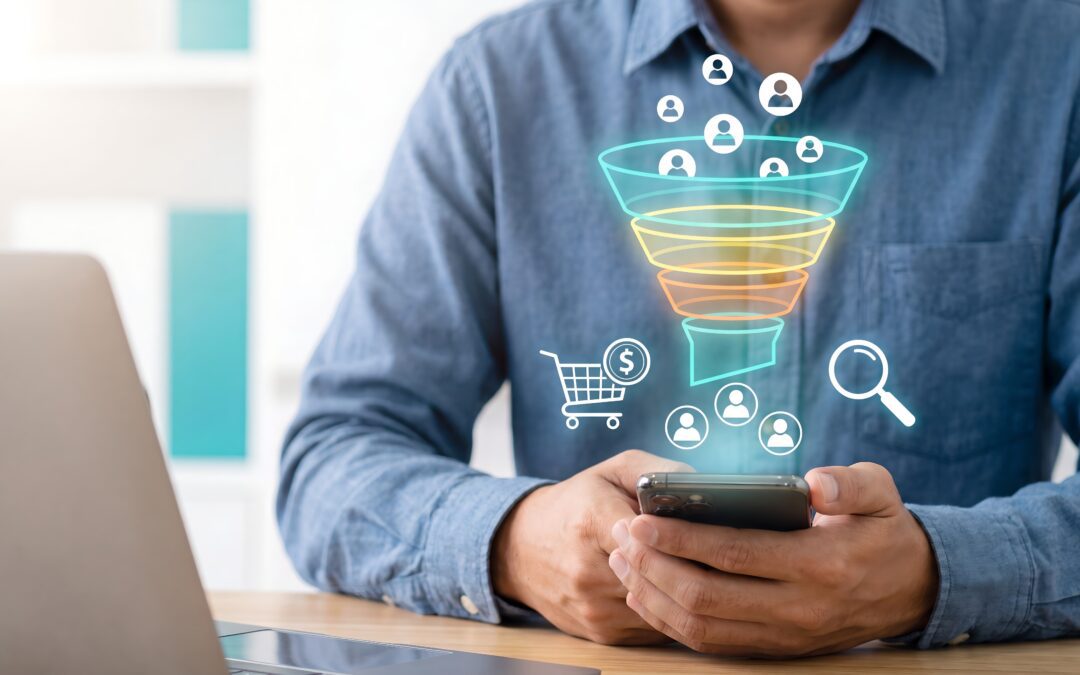
The marketing funnel is a model for describing how potential customers move from first learning about a product or service to buying it. Its history is surprisingly old.
The funnel’s history traces to E. St. Elmo Lewis, an American advertising pioneer who in 1898 described three principles that advertising should accomplish: attract attention; maintain interest; and create desire. Later versions of Lewis’ model added ‘action’, producing the familiar AIDA model:
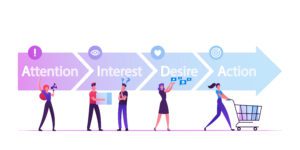
Lewis didn’t originally present this as the modern literal “funnel.” Rather, it was a way of thinking about the stages a person goes through before responding to an advertisement.
During the early 1900s, advertisers and sales organizations increasingly began thinking about customers as progressing though stages. A key development was the recognition that many more people encounter an advertisement than ultimately purchase the product. Therefor you could visualize the process as narrowing. This is the conceptual foundation of the funnel.
From this early conception, the modern funnel has evolved from a linear model of persuasion into a dynamic system for managing customer relationships and growth.
This article is part of the Sentinel Solutions local marketing newsletter. You can sign up here to get local marketing thought pieces sent to your inbox each week.
The essential idea that many prospects enter and fewer become customers is still useful. But today companies use the funnel in dramatically different ways. Today companies often build separate funnels for different audiences, products, channels, and behaviors. The funnels has consequently become less of a universal theory of consumer psychology and more of an operating model for measuring conversion.
The biggest practical change in the utilization of the marketing funnel came with the onset of digital marketing, giving companies the ability to measure movement between stages.
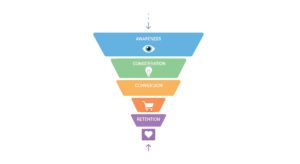
The modern marketing funnel is best understood as a continuous customer journey in which people move in and out of different stages based on their interests, behaviors, and needs. The traditional funnel, including awareness, consideration, and conversion, still provides a useful framework, but modern marketing extends well beyond the initial sale to include onboarding, retention, loyalty, and advocacy.
At the top of the funnel, the objective is to create awareness and establish relevance, using channels such as search, social media, display advertising, video, content, partnerships, and events. As people engage, marketers seek to understand their interests and behaviors, what they read, watch, click on, search for or respond to. Those signals allow marketing to become increasingly personalized, moving individuals from general engagement toward consideration and ultimately conversion.
Importantly, modern marketing is behavior-driven rather than simply demographic-driven. Instead of treating everyone in a particular age or demographic group the same, marketers use observed behavior and customer data to determine what someone is likely to need next. A person who repeatedly visits a product page, for example, should receive a different message than someone who has only encountered the brand once. Technology and marketing automation make it possible to respond to those behaviors with increasingly relevant messages, offers, and experiences across email, web, advertising, social, and other channels.
The funnel also no longer ends when someone becomes a customer. Conversion is the beginning of the customer relationship. Effective marketing then focuses on onboarding and activation, helping the customer quickly experience the value they purchased; followed by retention, loyalty, and ultimately, advocacy. The goal is to increase engagement and lifetime value while turning satisfied customers into repeat customers, referrers, and ambassadors for the brand.
How does the marketing funnel relate to the customer journey?
The marketing funnel and the customer journey are closely related, but they serve different purposes. The funnel is primarily a marketing framework for understanding movement toward a desired outcome, while the customer journey is the actual experience a person has with the organization across all touchpoints. The funnel describes what the organization is trying to accomplish; the customer journey describes what the customer is actually experiencing.
In a modern organization, the two should be connected. Customer journey mapping identifies the important moments and potential friction points in the relationship while the funnel identifies how marketing can influence those moments and move people toward the next stage. Data and behavioral signals then allow the organization to personalize the experience rather than treating everyone in a particular funnel stage identically.
The customer journey is the strategic framework. The marketing funnel is the operating framework.
The power of the modern funnel is that each stage has a distinct objective, audience, marketing intervention, and set performance measures. Rather than thinking about marketing as a collection of separate campaigns, the modern approach connects these activities into a coordinated customer journey, using data and behavioral tracking to determine the right message, offer, and experience at the right moment.
Understanding and using the marketing funnel provides a framework for turning audience and customer behavior into purposeful marketing action. It helps an organization understand where people are in their relationship with the brand, identify what they need at each stage, and deliver the right message, offer, and experience to move them toward the next stage. By connecting awareness, engagement, conversion, activation, retention, and advocacy, the funnels also helps align marketing efforts across channels and measure performance more effectively. Most importantly, it shifts marketing from a collection of disconnected campaigns to a coordinated, data-informed process for building relationships, increasing conversion, strengthening retention, and maximizing customer lifetime value.
Far more than Mr. Lewis ever anticipated.
To learn more about how to utilize the marketing funnel to improve the efficacy of your marketing and marketing investment, give us a call here at Sentinel Solutions. We’re expert at marketing and building effective campaigns to help your business grow. Visit our website (here) or give us a call at 603-352-5896 or email Advertising@SentinelDigitalSolutions.com.
We’re here to help you succeed.
Disclosure: This post was curated with AI assistance.
Additional Resources:


