
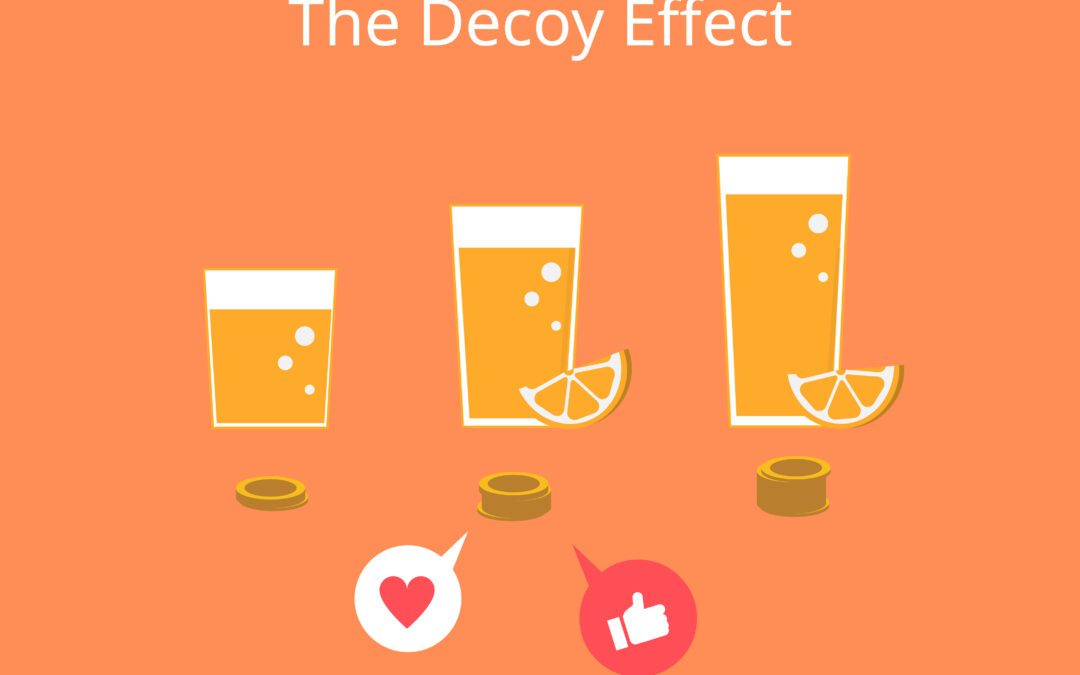
Decoy pricing is a strategy where a business introduces a third price/product option, purposely chosen because it is not meant to sell well, but rather to make another of the options look like a much better deal.
Instead of offering just two choices, a business adds a ‘decoy’ option that is clearly worse than one of the others, but similar enough to influence the customer’s comparison.
An infamous example often cited in behavioral economics is The Economist magazine, which offered three options:
- An online-only subscription for $59.00
- A print-only subscription for $125.00 (the decoy)
- A print + online subscription for $125.00
In this example almost no one chose the print-only option because you could get both print and online for the same price. Precisely what The Economist intended. The print-only option serves as the decoy in this example because it’s clearly a lesser value than print + online and exists only to make the combination offer look like a better deal.
Without the decoy, buyers would likely compare the $59.00 offer with the $125.00 offer and simply choose the cheaper option. With the decoy consumers likely think $125.00 for print-only vs. $125.00 for both…And choose the clearly superior offer.
Often consumers don’t choose based on absolute value, they instead choose based on relative comparisons.
This article is part of the Sentinel Solutions local marketing newsletter. You can sign up here to get local marketing thought pieces sent to your inbox each week.
Decoy pricing leverages a few cognitive biases:
- The Relativity Bias: We tend to judge value by comparison, not absolute worth.
- Asymmetric Bias: One option (the decoy) is clearly worse than another, pushing us toward the better one.
- Decision Simplification: The strategy reduces uncertainty by making one choice feel obvious.
Some might consider this pricing strategy as manipulative, but it depends on how it is used. At its core, decoy pricing is just a way of structuring choices. It becomes manipulative when it nudges people toward a decision they wouldn’t otherwise make, especially without them realizing it.
Decoy pricing is considered fair when all the options presented offer real, honest value; pricing is transparent, and the decoy isn’t deceptive, just less attractive.
The Economist example is clever but manipulative, in our opinion, because the decoy option isn’t really meant to be chosen. Decoy pricing should only be used when all options are genuinely useful, and the decoy exists to clarify value, not trick you.
What is an ethical example of decoy pricing? Imagine a hypothetical cloud storage company offering:
- Basic Plan: 100 GB of storage for $5.00 per month
- Standard Plan: 200 GB of storage for $9.00 per month
- Professional Plan: 2 TB of storage for $10.00 per month
In this example the Standard Plan is the decoy because it’s clearly worse than the Pro Plan (almost the same price for far less storage) and nudges the consumer toward the Pro Plan. The difference between this plan and The Economist plan is that the Standard Plan has real value for someone who needs less than 200 GB of storage. There is no deception, the storage amounts are clear and transparent; there is no fake option, and the plan isn’t artificially constructed to mislead. And mostly, the benefit is real: The Pro Plan is genuinely a better deal, it’s not just framed that way.
Local businesses can use decoy pricing effectively without being manipulative, but it requires discipline. The goal isn’t to ‘push’ customers into spending more; it’s to make the best value option easier to recognize. Here’s how your business can manage this effectively:
- Start with real customer needs. Before designing tiers, identify actual customer segments. Each option, including the decoy, should map to a real use case, not just exist to steer behavior.
- Make every option legitimately valuable. No option should feel like a trap.
- Be transparent and easy to compare. Clarity builds trust. Show prices transparently, clearly list what is included and avoid hiding limitations in fine print.
- Use the decoy to highlight true value, not inflate it. Is your premium option actually better or just positioned to look better?
- Protect long-term value over short-term gains. For local businesses, reputation is everything. If a customer feels nudged into overspending, they may never return and your word-of-mouth reputation suffers.
Here are the things to avoid:
- Don’t create an option nobody would reasonably choose.
- Don’t price two tiers identically just to force a decision.
- Don’t hide key differences or limitations.
- Don’t use confusing bundles to overwhelm customers.
For local businesses the winning mindset is to use pricing to clarify value, not to manufacture it. If every option is honest, useful, and fairly priced, the decoy pricing becomes less about manipulation and more about good communication.
Decoy pricing, used ethically and effectively, can deliver strong results for your local business.
- A well-known pricing experiment (Novabrandworks) showed that without a decoy, 68% of consumers chose the cheaper option. With a decoy, 84% chose the premium option, resulting in a +43% increase in revenue. Same product, same prices, just adding a decoy shifted demand dramatically.
- Adding a decoy raises the probability of choosing the target product. Typical studies show a +10% to +30% shift toward the target options is common in laboratory settings.
- A study by Science Direct indicates that decoys increase the proportion of users choosing a specific option and reduce ‘no purchase’ decisions.
Decoy pricing is a strategy rooted in behavioral economics where a business introduces a third, less attractive option to make another choice appear more valuable by comparison. When used well, it helps customers make clearer decisions and can increase selection of higher-value offerings. When used poorly, it can feel manipulative. At its best, decoy pricing doesn’t create value, it simply makes the real value easier to see.
To learn more about decoy pricing and other viable pricing tactics we encourage you to give us a call at 603-352-5896 or email Advertising@SentinelDigitalSolutions.com.
We are experts in local marketing and can help you build a compelling campaign that engages your audience and drives sales.
We’re here to help you succeed.
Visit us at SentinelDigitalSolutions.com to learn more about us.
Disclosure: This post was curated with AI assistance.
Additional Resources: